
One live capability
Make the decisions around it clearer.
Choose one product investment, AI capability, agent or workflow. Work through what it is for, what it may do and who owns what follows.
You can start with something already running or something you’re considering. Bring the judgement card to the people involved and compare your answers.
Use it with your team
1. Pick one capability.
An agent, an automated workflow or something you’re considering. Choose one whose decisions you can influence.
Be specific enough that everyone knows what you’re discussing. “AI in customer support” is broad. “The agent that sorts incoming support requests and drafts replies” gives you something concrete to examine.
2. Answer separately, then compare.
Everyone fills in their own judgement card first. Then compare what you each assumed and what you can learn from the differences. Leave a question open if you don’t know the answer.
The disagreements are the useful part.
You’re finding out how each person understands the capability and the decisions around it. What did someone else notice that you hadn’t considered?
3. Choose your re-earn point.
Pick a specific date when you’ll ask whether you would start again, knowing what you know then. Choose it around when you’ll have useful evidence.
Write the actual day, month and year in the Review date space on your downloaded card. Put it in the diary, name who will review it and agree who can change or stop it.
Act sooner if the evidence calls for it.
Your judgement card
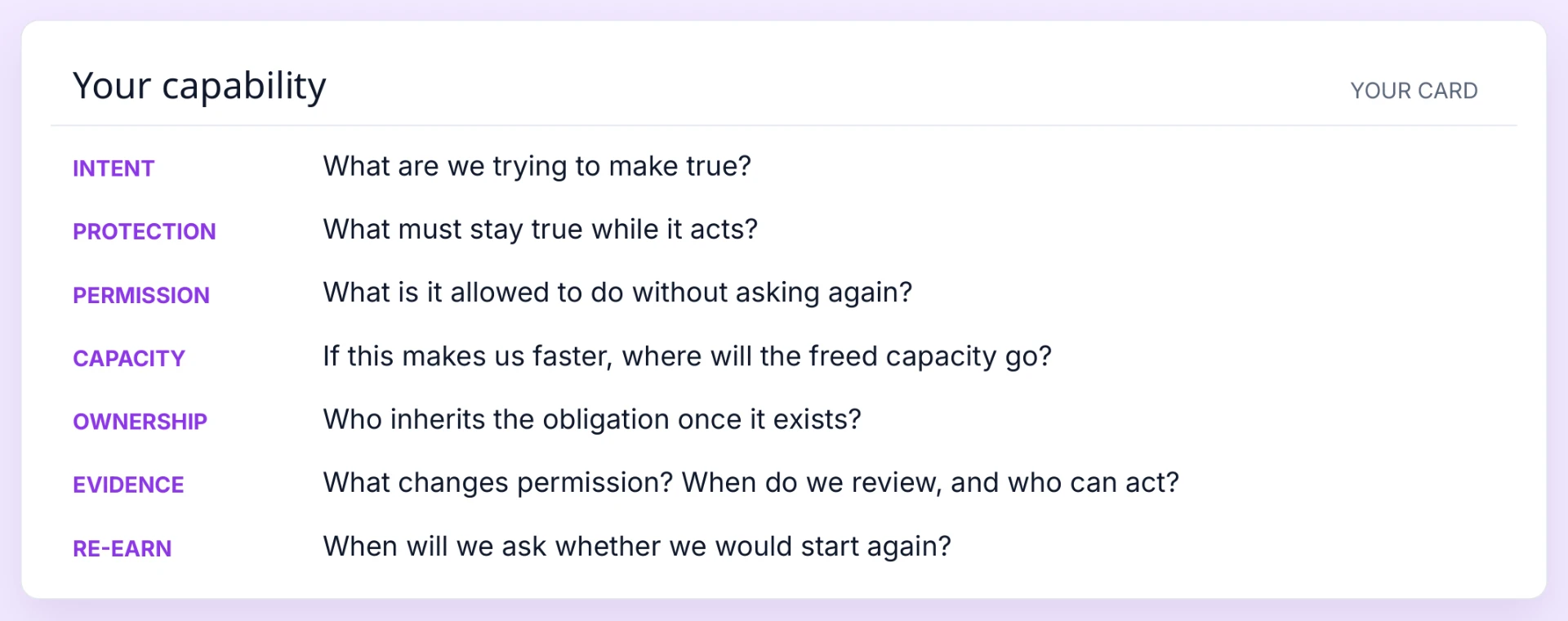
Read the card questions
My capability
Name the specific capability, agent or workflow.
- Intent
- What are we trying to make true?
- Protection
- What must stay true while it acts?
- Permission
- What is it allowed to do without asking again?
- Capacity
- If this makes us faster, where will the freed capacity go?
- Ownership
- Who inherits the obligation once it exists?
- Evidence
- What changes permission? When do we review, and who can act?
- Re-earn
- When will we ask whether we would start again?
Review date
Choose a specific calendar date and write it on your downloaded card.
Two-sided A5 card, ready to download and reuse with your team.
Kim’s worked example
Kim is the illustrative product leader from the keynote. She chooses one capability from her Monday, a support triage agent.
The agent can sort incoming requests and prepare replies. Kim works with the people responsible to agree its purpose, boundaries and ownership.
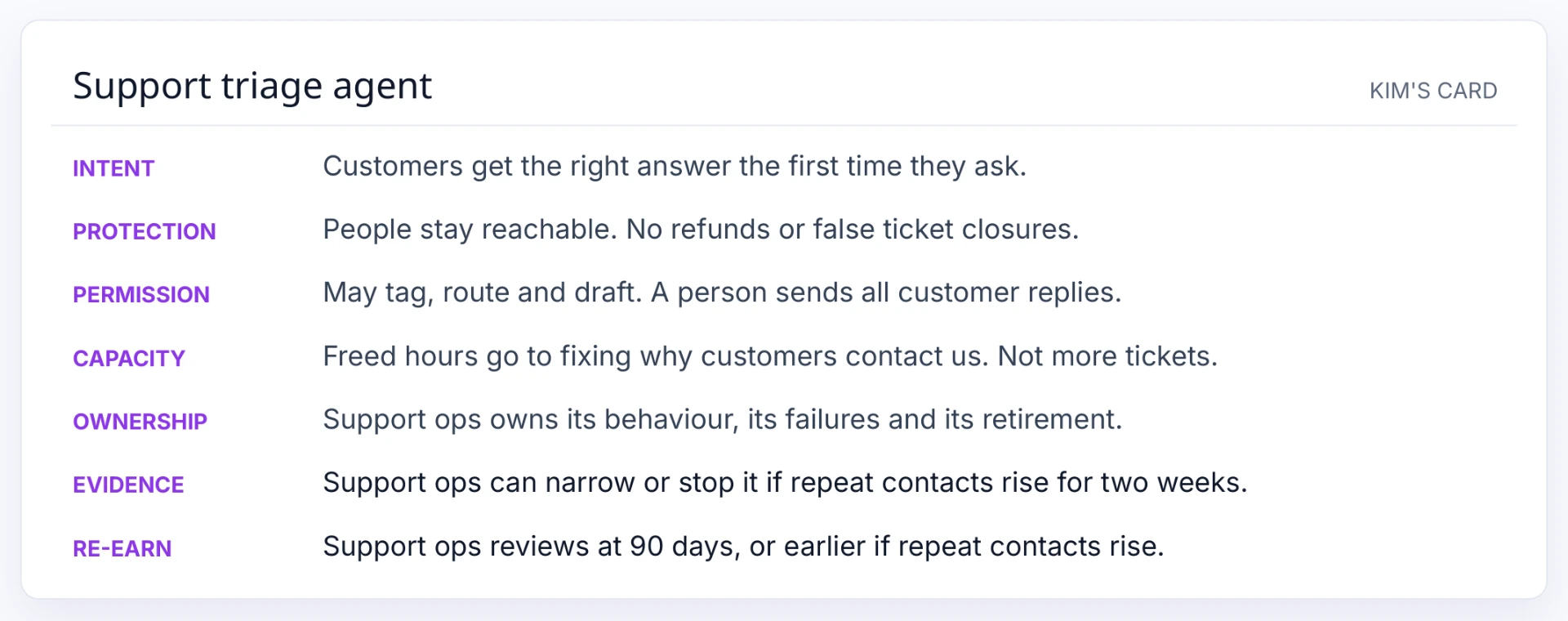
Read Kim’s answers
Capability
Support triage agent
- Intent
- Customers get the right answer the first time they ask.
- Protection
- People stay reachable. No refunds or false ticket closures.
- Permission
- May tag, route and draft. A person sends all customer replies.
- Capacity
- Freed hours go to fixing why customers contact us. Not more tickets.
- Ownership
- Support ops owns its behaviour, its failures and its retirement.
- Evidence
- Support ops can narrow or stop it if repeat contacts rise for two weeks.
- Re-earn
- Support ops reviews at 90 days, or earlier if repeat contacts rise.
The conversation behind the card
“Support ops” still needs a named person with time to monitor the agent and authority to change, narrow or stop it.
A false closure or an unapproved promise needs immediate escalation. Nobody waits for a two-week trend or the scheduled review.
Ninety days is the review point chosen for this illustration. Kim’s team would turn that into an actual calendar date before launch and put it in the diary. Choose yours around when you expect useful evidence and the consequences of getting it wrong.
The card makes the agreed decisions visible. The team still has to put those boundaries into practice and check what actually happens.
The completed keynote card, with notes on ownership, escalation and choosing a review date.
Start with the question you couldn’t answer
Take it to the people involved. An unclear answer about intent, permission or ownership is a useful place to begin.
A practical resource from Frances Ibe, Worth Building.